Skip to content
After supporting more than 1,600 fabricators worldwide with over 13,000 Tekla-based detailing packages, we have watched the same transformation happen hundreds of times: a shop that once spent half its week fighting drawing errors, reprogramming CNC machines, and fixing field clashes suddenly runs like clockwork. Welders weld, fitters fit, cranes lift, and management finally has time to focus on winning the next job instead of putting out fires.
The difference is never luck. It is the direct result of professional steel detailing services engineered specifically for fabricators’ reality — not the engineer’s intent, not the architect’s vision, but the shop floor. In this in-depth guide, we are sharing the exact systems, workflows, and daily practices that the most productive fabricators now treat as non-negotiable.
Table of Contents

Why Most Detailing Slows Fabricators Down (Even When It Looks “Fine”)
Generic or in-house detailing often creates invisible drag on shop productivity:
- Members split at theoretical locations instead of mill, shipping, or galvanizing breaks
- Connections designed for calculation simplicity rather than robotic welding or bolt access
- Fitting material (stiffeners, backing bars, rat holes) left as “shop add” notes
- CNC files requiring manual cleanup before the beam line will accept them
- Drawings issued without lot sequencing, forcing the yard to hunt for pieces
Professional detailing services built for fabricators eliminate every one of these bottlenecks before the first model is opened.
The Seven Core Practices That Transform Shop Efficiency
1. Fabrication-First Modeling from Minute One
We model exactly how your shop will build and ship:
- Members split at real mill lengths, truckable limits, and galvanizing batch sizes
- Connections use your preferred bolt spacing, edge distances, weld types, and robot compatibility
- All coping, blocking, rat holes, camber, and vent/drain holes fully modeled — never noted
- Shipping marks and piece marks follow your exact yard logic
The model becomes a direct extension of your shop standards.
2. Lot-Based Organization and Release Strategy
From day one the model is divided into logical fabrication and erection lots (columns + vertical bracing, floor beams, roof steel stairs, etc.). Every report, drawing, CNC file, and shipping list is filtered by lot automatically. Material arrives on the floor exactly when needed — no more 400-beam chaos in the yard.
3. Direct, Zero-Touch Digital Deliverables
We deliver native, machine-ready files for every major system:
- DSTV/NC1 for beam lines
- KISS/XML for plate nesting and burning
- Complete robotic welding programs (Voortman V-series, Ficep Endeavour, PythonX, Zeman, Peddinghaus)
- EJEK-compatible bolt lists and assembly sequences
Most clients eliminate manual programming labor completely within the first two projects.
4. Paperless Shop Floor Integration
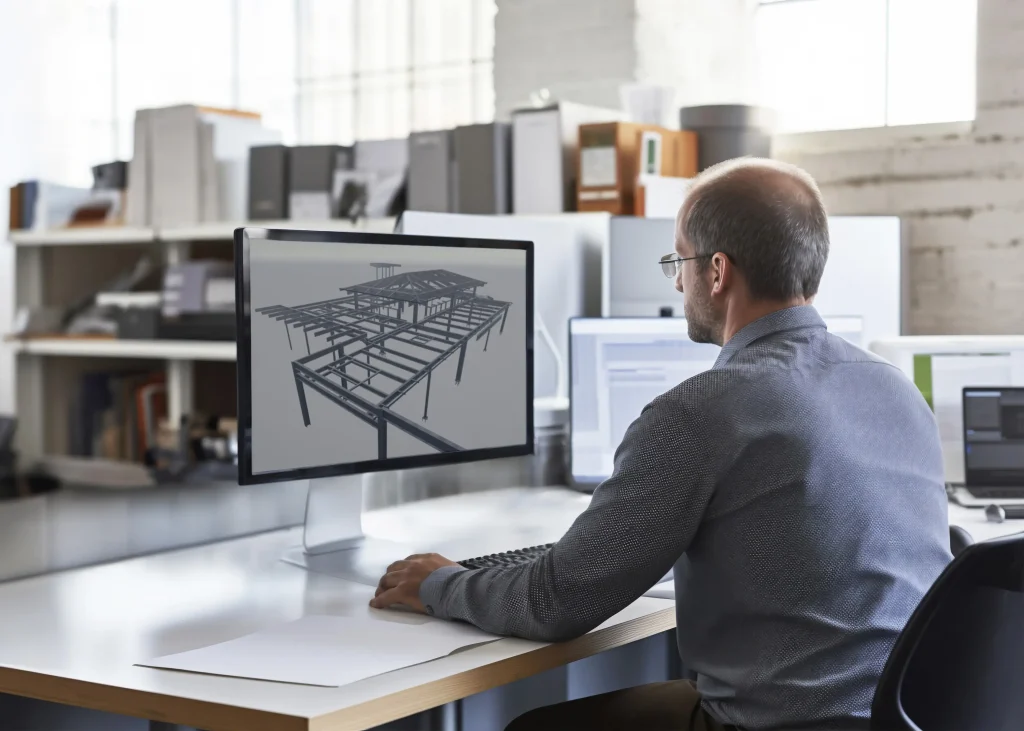
Welders, fitters, and QC teams view the live Tekla model on rugged tablets via Trimble Connect. No more printed revisions, sticky notes, or “which drawing is current?” confusion. A fitter marks an issue directly on the model; the fix is pushed globally in minutes.
5. Embedded Constructability Workshops
Before any drawings are issued, we hold virtual walkthroughs with your shop superintendent, lead welder, and crane supervisor. Typical outcomes:
- Re-sequenced heavy cages for overhead crane reach
- Adjusted cope depths for robotic cutting heads
- Standardized plate thicknesses to match your inventory
- Designed temporary strongbacks for safe handling
These sessions routinely save weeks of shop time.
6. Continuous Weight & COG Monitoring
The model tracks weight and center of gravity in real time. Any change that moves COG more than 50 mm or weight more than 100 kg triggers an instant alert — preventing load-out surprises and expensive re-sequencing.
7. Ruthless, Multi-Layer Independent Checking
Our standard protocol:
- Detailer self-check
- 100 % independent second senior detailer review
- Separate connection engineer constructability pass
- Nightly automated health scripts
- Final fabricator sign-off before release
We reject 17–24 % of packages internally — because catching an error in the office is infinitely cheaper than catching it on the shop floor.

Real Productivity Gains Our Fabricator Partners Experience
- Midwest U.S. fabricator (8,000 tons/year)
- Reduced shop labor hours per ton by 21 %
- Eliminated weekend overtime on detailing-related delays
- Doubled fitting bay throughput after going fully paperless
Australian stadium contractor
- Received first erection drawings in 19 days
- Full shop package in 8 weeks
- Finished steel erection 16 days early
Canadian industrial shop
- Cut beam-line programming time from days to minutes
- Reduced scrap from mis-cut parts by 94 %
- Freed 2,200 ft² of office space by dissolving in-house detailing department
These are normal, repeatable outcomes when detailing is built for fabricators instead of against them.
The Efficiency Checklist Every Fabricator Should Demand
Before awarding your next package, require proof of:
- Fabrication-first modeling standards coded into every project
- Lot-based organization from day one
- Direct robotic/CNC exports requiring zero manual programming
- Live model access for welders and fitters via tablet
- Documented constructability workshops with shop leadership
- Internal rejection rate above 15 % (proof of rigorous checking)
- Hybrid project management in your time zone
If a detailer cannot demonstrate every item, your shop productivity will suffer.
Frequently Asked Questions

How quickly do fabricators see measurable productivity improvements?
Most clients report visible gains on the very first project and dramatic transformation by the third. Programming labor drops immediately, scrap plummets within weeks, and yard flow improves as lot-based releases take hold.
Will this level of detailing service work for smaller fabricators?
It works even better. Smaller shops have tighter margins and less tolerance for waste. The practices above routinely turn marginal jobs into highly profitable ones for our 800–6,000-ton partners.
Do we lose control when we outsource detailing?
The opposite. Because the model is live and cloud-based from week one, you have more real-time visibility and control than with most in-house teams. You approve every lot before release and can mark up the model directly from the shop floor.
Conclusion

The highest-performing fabricators today do not hope their detailing will be efficient — they partner with services that systematically remove every bottleneck, every manual step, and every preventable error before steel ever hits the saw.
When your shop drawings are modeled exactly as you build, when CNC machines run directly from the model without human touch, when welders work from live tablets instead of paper stacks, and when material flows in perfect sequence, your shop stops fighting the drawings and starts printing money.
That reality is available today — but only when you choose a detailing partner that understands fabrication as deeply as you do.
We have spent more than fifteen years perfecting the exact fabricator-first process that delivers these outcomes on every project, regardless of size or complexity.
If you are ready to stop losing hours, dollars, and weekends to preventable detailing issues, let’s talk.
We will review one of your recent or upcoming jobs at no cost, build a live sample package using your exact shop standards, and let you experience the difference firsthand.