Skip to content

Manufacturing facilities demand steel structures that perform under constant stress—vibration from heavy machinery, dynamic loading from overhead cranes, thermal expansion in high-temperature environments, and the need for future-proof flexibility when production lines change. That’s why precision steel detailing isn’t optional for these projects; it’s the foundation that keeps operations running smoothly, minimizes costly downtime, and protects your capital investment.
We specialize in delivering Tekla Structures-powered precision detailing exclusively for manufacturing plants across the United States. Our team understands that a single misaligned connection, incorrect crane rail tolerance, or overlooked MEP penetration can halt production for days or weeks. We eliminate those risks by producing shop drawings, erection plans, CNC data, and material lists that are accurate to the millimeter, fully coordinated, and ready to feed directly into your fabrication process.
From automotive assembly lines and food processing plants to semiconductor fabs, chemical facilities, and heavy equipment manufacturing, we’ve partnered with fabricators nationwide to create steel frameworks that support mission-critical operations without compromise.
Why Manufacturing Facilities Require a Higher Standard of Steel Detailing Precision
Unlike commercial or warehouse projects, manufacturing environments impose unique demands on the steel structure:
- Dynamic and fatigue loading from presses, stamping machines, conveyors, and robotic arms
- Overhead crane systems with precise runway alignment, runway beam splices, and column bracing
- Vibration control requiring tuned mass dampers, isolated foundations, or specialized bracing
- High-clearance bays with long-span trusses or joist girders
- Frequent MEP integration—large process piping, HVAC ducting, dust collection systems, and utility trenches
- Future adaptability—designs that allow for new equipment additions without major structural modifications
Generic detailing approaches often fall short here. Tolerances that work for a retail building become unacceptable when a 50-ton crane needs to travel smoothly across a 400-foot span. We approach every manufacturing project with the understanding that the steel must support 24/7 production reliability, not just code minimums.
The Hidden Costs of Imprecise Detailing in Manufacturing Environments
Downtime in a manufacturing facility is measured in thousands—or tens of thousands—of dollars per hour. Even minor detailing errors create cascading problems:
- Misaligned crane rails force shimming or re-alignment, delaying commissioning
- Incorrect member camber or seat depths disrupt mezzanine floor flatness for precision equipment
- Uncoordinated openings require field cutting of beams or deck, compromising fire ratings and load paths
- Poor bracing layouts amplify vibration transmission to sensitive machinery
- Late or inaccurate material lists cause production delays waiting for missing pieces
Industry data shows that detailing-related issues contribute to 20–35% of unexpected costs on industrial projects. We exist to reverse that statistic through obsessive attention to detail and proactive coordination.
Key Precision Elements We Control in Every Manufacturing Project
- Crane runway tolerances — Alignment within 1/8 inch over 100 feet, per CMAA and AISC guidelines
- Vibration-sensitive connections — Snug-tightened high-strength bolts, isolation pads, and damping details
- Process equipment supports — Custom base plates, embedded anchors, and reinforcement for point loads
- Expansion joint detailing — Allowing for thermal movement without compromising diaphragm shear
- Maintenance access platforms — OSHA-compliant catwalks, ladders, and davits integrated early
These elements receive the same rigorous modeling and checking as primary framing.

Leveraging Tekla Structures for Manufacturing-Grade Precision
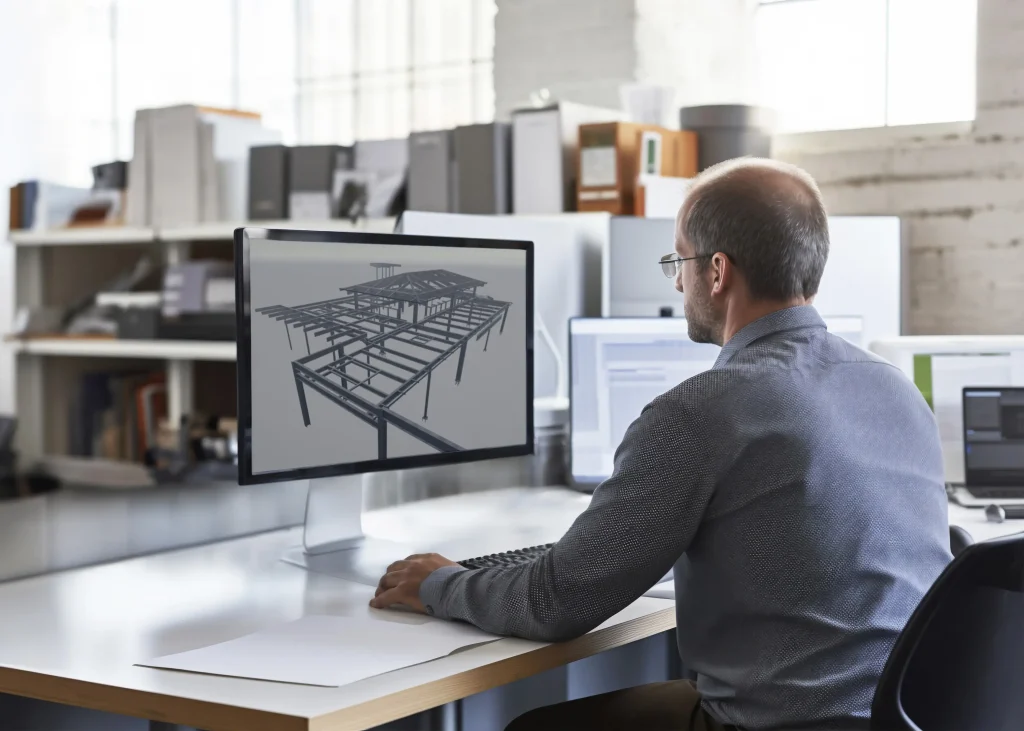
Tekla Structures is the industry benchmark for complex industrial detailing because it handles the scale, intelligence, and coordination manufacturing projects demand.
We use Tekla’s parametric capabilities to:
- Model every crane rail clip, splice plate, and alignment shim
- Automatically calculate and apply differential camber for multi-span girders
- Embed precise MEP penetrations with reinforcement details
- Generate intelligent reports for vibration analysis inputs
- Produce CNC-ready NC1 files, DSTV profiles, and FabTrol exports
Because Tekla maintains a single, live model, any change—whether from an engineer’s RFI, a late equipment vendor drawing, or a process line revision—updates across all deliverables instantly, preventing version control disasters.
Full Coordination Between Structural Steel and Process Systems
Manufacturing facilities live or die by integration. We routinely import architectural, MEP, and process equipment models (Revit, Navisworks, Plant 3D, or vendor STEP files) into Tekla to perform comprehensive clash detection:
- Large-bore piping routing around bracing
- Dust collection ductwork clearances
- Electrical bus duct and cable tray supports
- Fire suppression system penetrations
- Robotic arm reach envelopes
This early coordination eliminates the field conflicts that traditionally plague manufacturing builds.
Specialized Detailing for High-Precision Manufacturing Sectors
Different industries require tailored precision:
- Automotive & Aerospace — Tight tolerances for robotic positioning and paint booth ventilation
- Food & Beverage — Sanitary detailing, stainless components, and cleanable surfaces
- Semiconductor & Pharmaceuticals — Vibration-isolated floors and ultra-clean steel finishes
- Heavy Machinery — Oversized built-up sections and fatigue-resistant welds
- Chemical & Energy — Corrosion-resistant coatings and explosion-resistant bracing
We adapt our Tekla workflows to meet each sector’s unique standards while maintaining AISC, AWS, and project-specific compliance.

Our Proven Process for Delivering Manufacturing-Ready Precision Detailing
We follow a disciplined, transparent workflow designed for industrial complexity.
Phase 1: Early Collaboration & Load Definition
We begin with detailed discussions about equipment schedules, vibration criteria, crane specifications, and expansion requirements—capturing everything before modeling starts.
Phase 2: Intelligent 3D Modeling in Tekla
Building a comprehensive model that includes primary steel, secondary framing, MEP sleeves, equipment embeds, and vibration controls.
Phase 3: Multi-Trade Clash Resolution
Iterative coordination rounds with architects, MEP engineers, and equipment vendors to resolve conflicts virtually.
Phase 4: Precision Deliverables & Documentation
Producing shop drawings, erection sequences, CNC data, detailed BOMs, and vibration analysis support documents.
Phase 5: Rigorous Quality Assurance
Automated checks, full 3D clash review, peer detailing review, senior engineer sign-off, and final client walkthrough.
This process consistently yields submittals that engineers approve with minimal comments and fabricators run without rework.
Frequently Asked Questions
How do you ensure crane runway alignment precision in Tekla models?
We model rail clips, splice plates, and alignment shims parametrically, apply CMAA tolerances directly in the model, and generate survey control points and installation sequences that maintain straightness and levelness within 1/8 inch over 100 feet.
Can you coordinate detailing with proprietary manufacturing equipment vendors?
Yes. We routinely import vendor 3D models (STEP, IFC, or native formats) into Tekla to detail exact support locations, anchor patterns, clearance envelopes, and vibration isolation details—ensuring seamless integration before steel fabrication begins.
What turnaround times can we expect for a mid-sized manufacturing facility project?
For typical 400–1,200-ton industrial buildings, initial submittal packages are delivered in 5–9 weeks, with phased releases for crane systems and equipment zones to support aggressive commissioning schedules. We provide a customized timeline during our initial consultation.

Conclusion
Manufacturing facilities represent some of the most demanding steel construction projects in the country—where precision detailing directly impacts production uptime, equipment longevity, and overall plant profitability. We combine Tekla Structures expertise, deep industrial knowledge, and an uncompromising focus on accuracy to deliver shop drawings and erection plans that perform under real-world manufacturing conditions.