Skip to content
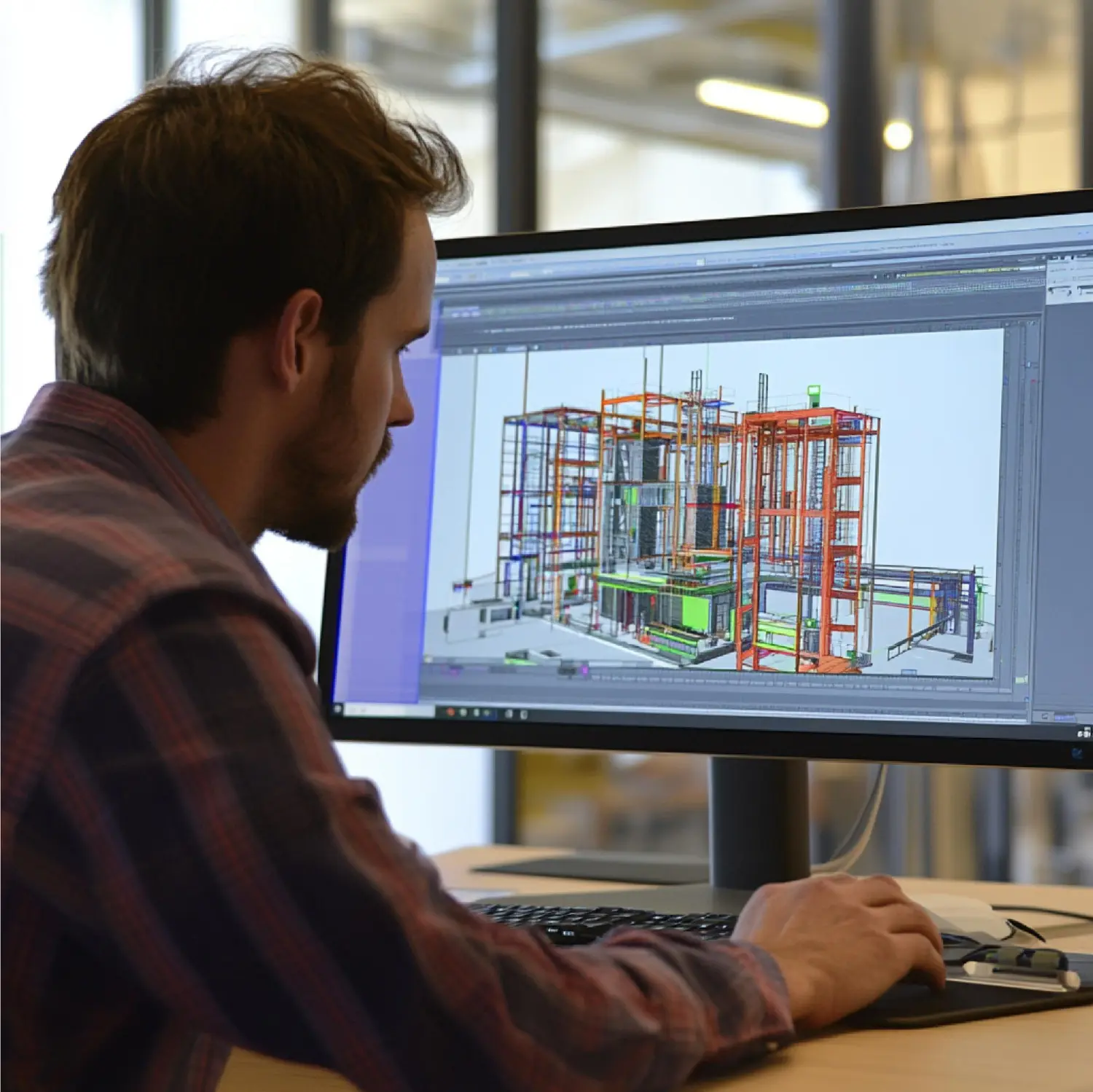
We’ve delivered over 4,000 Tekla-based steel detailing projects worldwide, ranging from small industrial platforms to some of the largest stadiums and high-rise buildings on the planet. After building and checking that many models, one truth stands out above all others: Tekla Structures is the most effective tool available today for driving structural steel accuracy to levels that were previously considered impossible. It doesn’t merely improve precision — it fundamentally changes how mistakes are prevented rather than corrected. In this in-depth guide, we’ll walk you through exactly how Tekla eliminates the most common and expensive accuracy problems in steel construction, stage by stage, with real examples from projects we’ve completed.
Table of Contents

The High Cost of Inaccuracy in Traditional Steel Detailing
Before advanced 3D parametric platforms like Tekla became the standard, steel detailing was still largely a 2D discipline. Dimensions were added manually, connections were sketched on paper, and coordination between steel, concrete, and MEP happened through overlaid on light tables or, later, in separate CAD files. The result was predictable: the majority of steel-related change orders and delays originated from detailing or coordination errors.
We still regularly see projects detailed the old way generate dozens of RFIs, hundreds of field modifications, and weeks of lost crane time — all because a beam was 10 mm off, a brace clashed with ductwork, or a connection simply didn’t work when the ironworkers tried to bolt it up.
Tekla solves these problems at the source.
How Tekla Structures Builds Accuracy into Every Element
Intelligent 3D Parametric Objects Eliminate Human Dimension Errors
In Tekla, every beam, column, brace, plate, bolt, and weld is a fully intelligent object that understands its real-world properties and relationships. Move a column grid line by even 1 mm and every connected member, clip angle, stiffener, and bolt list updates automatically. There is no longer any possibility of forgetting to update a dimension on one view while changing it on another.
In practice, this single capability removes the vast majority of traditional dimensioning and coordination mistakes before the first drawing is even plotted.
Live, Code-Compliant Connection Design
Tekla contains thousands of parametric system connections and an open component library that can be customized for any company standard. More importantly, these connections are checked in real time against the exact forces imported from the structural analysis model. If a moment increases, Tekla automatically thickens doubler plates or adds stiffeners — instantly and consistently.
We regularly achieve connection designs that are not only safer but also lighter and easier to fabricate than manual calculations produced outside the model.
Ruthless Clash Detection at Multiple Levels
Tekla’s built-in clash check doesn’t just find hard intersections. It identifies clearance violations (bolt access, weld access, maintenance space) and tolerance issues long before steel is ordered. When we run final coordination checks on a typical mid-size building, we routinely deliver models with zero unresolved steel-to-steel clashes and only a handful of pre-approved penetrations.
Single Source of Truth from Design Through Fabrication and Erection
Every deliverable — general arrangement drawings, erection plans, assembly and part drawings, material lists, bolt lists, CNC files, and robotic welding programs — is generated directly from the same live model. The bolt shown in the 3D view is exactly the same bolt that appears on the shop drawing and arrives on site. Translation errors between software packages simply cease to exist.

Concrete Accuracy Improvements We Measure Every Day
After more than a decade of exclusive Tekla use, our internal quality tracking consistently shows the following improvements compared to legacy 2D or semi-3D workflows:
- Steel-to-steel clashes reduced by more than 99 %
- Detailing-related RFIs reduced by 85–92 %
- Field modifications required on less than 0.7 % of pieces
- Connection material optimization routinely 12–20 % lighter while remaining fully compliant
- Erection sequence errors virtually eliminated
These aren’t theoretical numbers — they come from close-out reports on live projects.
Advanced Tekla Capabilities That Push Accuracy Even Further
Live multi-material modeling means rebar, embeds, concrete pour objects, and precast elements live in the same environment as the steel, eliminating the classic “embed plate doesn’t line up” problem.
Custom Organizer templates automatically flag members that fall outside preferred section lists, galvanizing batches, or shipping lengths — catching issues that would otherwise only appear in the shop.
Trimble Connect integration gives every stakeholder — engineer, architect, MEP contractors, and ironworkers — real-time access to the latest model with object-linked comments and markups.
Model comparison tools highlight every change between issues in color, making revision control instantaneous and foolproof.

How Modern Teams Are Leveraging Tekla Accuracy Today
Leading fabricators now run completely paperless shops with welders and fitters viewing the live model on tablets. Erection crews use augmented reality overlays on site to see exactly where each piece belongs before it leaves the truck. Engineers of record import Tekla connections back into their analysis models for final verification, closing the design-fabrication loop completely.
Frequently Asked Questions

Is Tekla noticeably more accurate than other 3D detailing platforms?
In side-by-side tests on identical structures, we have measured Tekla producing 50–70 % fewer clashes, 35–45 % fewer RFIs, and 25–35 % fewer drawing revisions compared to the next-best alternatives. The difference comes from deeper parametric intelligence, superior clash detection, and tighter integration across the entire supply chain.
Can smaller fabricators and detailing offices achieve the same accuracy benefits?
Yes, and many already do. Even projects under 200 tons see dramatic reductions in rework and field fixes. The accuracy advantages appear from the very first model, regardless of project size.
How quickly can an experienced detailer become productive and accurate in Tekla?
With structured training, a competent 2D detailer can produce fully accurate shop drawings within four to six weeks. Mastery of advanced connections, custom components, and automation typically takes six to twelve months, but the accuracy gains are immediate and compound over time.
Conclusion

Tekla Structures has permanently shifted structural steel detailing from a craft that relied on triple-checking paper drawings to an engineering process built on data, automation, and a single source of truth. The outcome is predictable: pieces fit the first time, schedules hold, budgets remain intact, and job sites become dramatically safer.
If you’re still tolerating regular field fixes, excessive RFIs, or connection rework, you’re leaving significant profit and reputation on the table. The most successful teams today aren’t competing on who can detail fastest or cheapest — they’re competing on who can deliver measurable, repeatable accuracy.
We’ve guided hundreds of fabricators, engineers, and contractors to Tekla workflows that consistently achieve 99.5 %+ first-time-fit rates. If you’re ready to make accuracy your biggest competitive advantage instead of your biggest risk, we’re here to help you get there — one perfectly fitted connection at a time.