Skip to content

A fabrication shop can only move as fast as the drawings feeding it. When shop drawings arrive with errors, missing piece marks, or connection details that don’t match the model, production stalls and crews sit idle waiting on clarification. We wrote this guide for fabricators who need to understand exactly what a professional shop drawing service should deliver — and how the right detailing partner keeps your shop running instead of waiting.
Below, we break down what shop drawings actually are, what separates a usable set from a problematic one, and how structural steel detailing services fit into your fabrication workflow from bid to erection.

What Are Steel Shop Drawings, Exactly?
Shop drawings are the fabrication-ready instructions derived from structural design documents — they tell your shop exactly how to cut, drill, weld, and assemble every piece of steel before it ever reaches the field. Unlike design drawings, which communicate engineering intent, shop drawings communicate manufacturing instructions: precise dimensions, piece marks, material grades, and connection details a fabricator can execute directly.
Shop Drawings vs. Erection Drawings
These two document types get confused often, but they serve different audiences. Shop drawings guide the fabrication shop through cutting and assembling individual pieces. Erection drawings guide the field crew through placing and connecting those pieces on-site. A complete detailing package needs both, cross-referenced so piece marks match exactly between the two sets — a mismatch here is one of the most common causes of field delays.
Why Accuracy at This Stage Determines Project Speed
Every dimension, weld symbol, and bolt hole on a shop drawing gets converted directly into shop labor. An error that would take five minutes to fix on a drawing can take hours to correct once steel has already been cut. This is why our detailing process treats shop drawing accuracy as a production issue, not just a documentation issue — the drawings are the first point where design meets manufacturing reality.

What a Professional Shop Drawings Service Should Include
A complete shop drawing package covers four core deliverables: fully dimensioned piece drawings, an accurate bill of materials, connection details tied to approved calculations, and CNC-ready data for automated fabrication equipment. Fabricators evaluating a detailing partner should confirm all four are part of the standard deliverable, not billed as extras.
1. Fully Dimensioned Piece Drawings
Each piece drawing needs complete dimensions, material specification, and a unique piece mark that ties back to the erection drawing. Anything ambiguous here gets kicked back to the shop floor as a question, which costs time your crew doesn’t have.
2. Bill of Materials (BOM)
An accurate BOM drives your material ordering and shop scheduling. It should list every piece with quantity, weight, and material grade, cross-checked against the 3D model rather than manually tallied — manual counts are where most quantity discrepancies originate.
3. Connection Details
Every bolted or welded connection on the shop drawing should trace directly back to an approved connection design calculation. This includes bolt pattern, hole type, weld symbol, and any field-verification notes the crew will need during erection.
4. CNC and NC File Compatibility
Shops running automated equipment — plasma cutters, drill lines, robotic coping machines — need detailing output compatible with their CNC systems. A detailing service that generates NC files directly from the 3D model eliminates a manual data-entry step that otherwise introduces its own error rate.
Common Shop Drawing Problems That Slow Down Fabrication
Most fabrication delays tied to shop drawings trace back to a handful of recurring issues: mismatched piece marks between shop and erection sets, outdated revisions circulating on the floor, incomplete connection details, and BOM quantities that don’t match the model. Recognizing these patterns helps fabricators evaluate whether their current detailing process needs improvement.
Comparing Manual Drafting vs. Model-Based Detailing
| Factor | Manual 2D Drafting | Model-Based Detailing (Tekla) |
|---|---|---|
| Dimension accuracy | Prone to transcription errors | Pulled directly from 3D model |
| Revision handling | Each view updated manually | Model update propagates to all views |
| Clash detection | Not available | Built into the modeling process |
| BOM generation | Manually tallied, error-prone | Auto-generated from model quantities |
| CNC file output | Requires separate conversion step | Generated directly from the model |
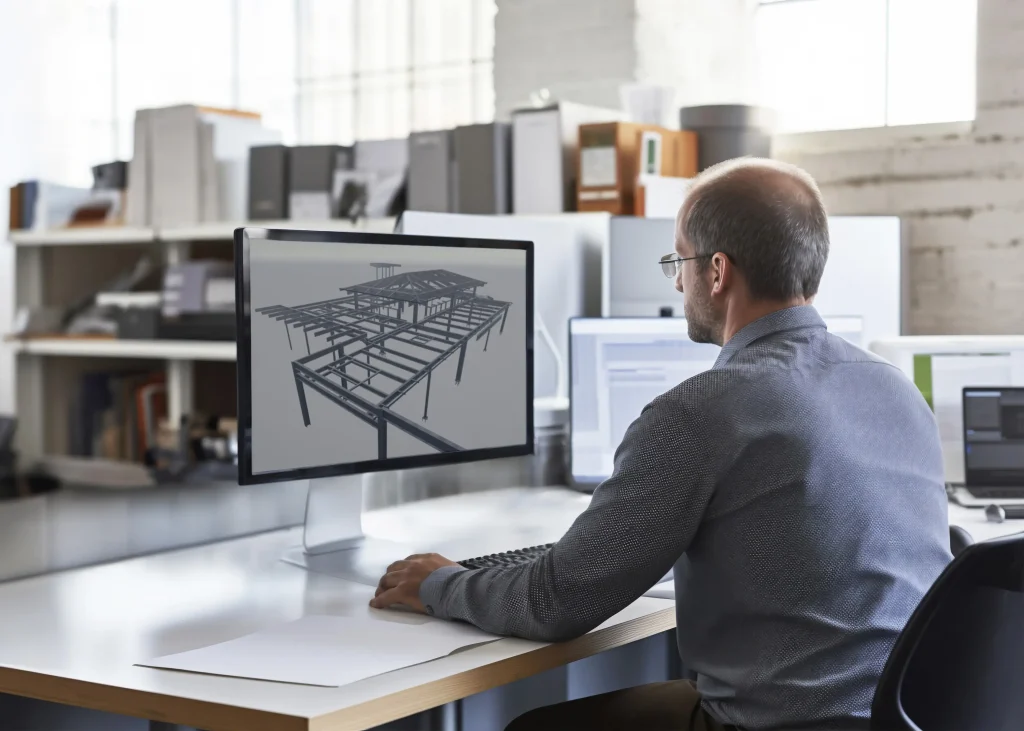
We rely on model-based detailing for every project because it removes the manual transcription errors that manual drafting simply can’t avoid. Understanding how Tekla Structures generates shop drawings, BOMs, and NC files from a single model is central to why fabricators see fewer RFIs when they switch from 2D-drafted packages to model-driven ones.
H3 | Handling Miscellaneous and Secondary Steel
Primary structural framing usually gets the most attention, but stairs, handrails, ladders, and platform steel carry their own detailing complexity and are frequently where errors slip through. A detailing partner with a dedicated process for miscellaneous steel detailing — separate from primary framing workflows — catches issues in these secondary items before they reach the shop.

Choosing a Shop Drawings Service: What Fabricators Should Ask
Before committing to a detailing partner, we recommend fabricators confirm the following:
- Does the service generate shop drawings directly from a 3D model, or from manual 2D drafting?
- What is the standard turnaround time for a shop drawing package, and how is expedited work handled?
- How are RFIs and revisions tracked and communicated back to the fabrication team?
- Does the package include CNC/NC file output compatible with your shop’s equipment?
- Is there a dedicated process for specialty scopes like steel joist and deck detailing, or is it handled the same as primary framing?
A detailing partner who can answer all five clearly is one who understands fabrication, not just drafting.
Frequently Asked Questions
How long does it take to receive shop drawings after submitting a project?
Turnaround depends on project complexity and scope, but a model-based detailing process typically delivers initial shop drawing packages faster than manual drafting because dimensions, BOMs, and connection details are generated directly from the 3D model rather than built view-by-view.
Can shop drawings be generated directly for CNC fabrication equipment?
Yes. When shop drawings originate from a 3D model, the same model data can generate NC files for plasma cutters, drill lines, and coping machines, removing the manual conversion step that a purely 2D-drafted package would require.
What’s the difference between outsourcing shop drawings and hiring in-house detailers?
Outsourcing gives fabricators access to detailing capacity that scales with project volume without carrying the fixed overhead of an in-house team, which is particularly useful for shops managing seasonal workload swings or multiple simultaneous projects.
Conclusion

Shop drawings are where structural design becomes fabrication instruction, and any inaccuracy at this stage moves directly into shop labor and schedule risk. The fabricators who avoid the most costly delays are the ones working with a detailing partner that builds shop drawings, BOMs, and CNC data from a single accurate 3D model — not from disconnected manual drafting steps prone to their own errors.