Skip to content

The United States stands at the threshold of one of the most ambitious infrastructure eras in modern history. As we move deeper into 2026, massive federal commitments, ongoing implementation of landmark legislation, and emerging policy initiatives are unlocking trillions in project funding. Headlines frequently reference figures around $1.5 trillion in potential infrastructure investment—whether through leveraged federal dollars, permitting reforms to release trapped funds, or targeted programs in transportation, energy, and resilience. This surge is not abstract policy talk; it translates directly into concrete demand for structural steel, fabrication capacity, and, crucially, expert steel detailing services.
At T&J Steel Detailers, we support fabricators nationwide who are ramping up to meet this wave. With over sixty experienced Tekla modelers delivering clash-free, CNC-ready drawings on accelerated timelines, we see the pipeline firsthand: bridges, rail expansions, grid upgrades, ports, and data center supports all require precision detailing to turn funding into finished structures without costly delays.
The Scale of the 2026 Infrastructure Surge
Federal infrastructure spending has evolved significantly since the Infrastructure Investment and Jobs Act (IIJA) of 2021, which authorized roughly $1.2 trillion overall, including $550 billion in new investments through 2026. As the final year of IIJA implementation unfolds, record obligations and outlays are flowing—highways, bridges, rail, transit, water systems, broadband, and clean energy projects are all accelerating.
Beyond IIJA, discussions in 2026 highlight efforts to unlock additional trillions potentially trapped in permitting delays. Industry analyses point to legislative proposals that could release $1.5 trillion or more in stalled projects through streamlined approvals and new funding mechanisms. Transportation-specific announcements, such as $1.5 billion in targeted grants for safety and efficiency, add momentum. Meanwhile, broader visions—including maritime security, defense-related builds, and resilience initiatives—further amplify the need for steel-intensive construction.
This convergence creates a multi-year demand supercycle. Fabricators report increased inquiries for heavy structural packages, long-span designs, and modular components. The common thread? Every major project demands meticulous steel detailing to ensure components fit seamlessly, connections meet load requirements, and erection proceeds on aggressive schedules.

The Benefits and Applications of Metal Structures
Steel remains the backbone material for America’s infrastructure renaissance, offering advantages that align perfectly with the scale, durability, and speed required in 2026 projects.
Unmatched Strength and Efficiency
Steel’s high strength-to-weight ratio enables longer spans, taller clearances, and lighter foundations—key for bridges crossing wide waterways, rail viaducts over urban areas, and expansive port facilities. Reduced foundation mass lowers concrete needs and site preparation costs, making projects more economically viable amid rising material prices.
Proven Durability and Resilience
In harsh environments—from coastal ports exposed to salt spray to seismic zones and high-wind corridors—steel delivers long-term performance. Properly detailed connections and members resist fatigue, corrosion (with appropriate coatings), and extreme loading, ensuring infrastructure withstands decades of service with minimal disruption.
Accelerated Construction Timelines
Prefabrication is steel’s superpower in a funding-driven boom. Shop-fabricated components arrive ready for rapid field assembly, compressing on-site work and minimizing traffic or operational interruptions. For time-sensitive projects like rail upgrades or grid reinforcements, this speed translates to earlier benefits for communities and faster ROI for owners.
Sustainability and Future-Proofing
Steel is infinitely recyclable without quality degradation, supporting green procurement mandates. Lightweight designs reduce embodied carbon in transport and foundations. Modular steel systems allow easy expansions or retrofits—vital as infrastructure needs evolve with climate adaptation, electrification, and population growth.

Diverse Infrastructure Applications Driving Steel Demand
The 2026 boom spans multiple sectors, each relying heavily on detailed steel frameworks.
Transportation Infrastructure dominates with highways, bridges, rail (including high-speed corridors), airports, and transit hubs. Long-span bridges and elevated rail structures consume thousands of tons of beams, girders, and braces per project.
Energy and Grid Modernization require steel for transmission towers, substation supports, renewable energy platforms (wind/solar mounting), and pipeline racks. Data centers and EV charging networks add demand for robust building frames and utility supports.
Ports, Waterways, and Maritime Facilities use steel for docks, cranes, bulkheads, and navigation aids, enhancing trade capacity and resilience against storms.
Water and Environmental Projects incorporate steel in treatment plants, flood barriers, levees, and stormwater systems, where corrosion-resistant detailing ensures longevity.
Defense and Resilience Builds—including border infrastructure and critical facility hardening—rely on steel’s ductility and rapid deployability.
Across all these, precise steel detailing ensures that the material’s benefits are fully realized: zero field modifications, optimized material use, and structures that perform safely under design loads.
Why Steel Detailing Demand Is Surging in 2026
With funding flowing and projects breaking ground, the bottleneck shifts to execution. Fabricators face compressed bid-to-build windows, larger tonnages, and complex integrations (e.g., with mechanical systems or seismic bracing). Inaccurate or delayed detailing leads to RFIs, rework, material waste, and schedule slippage—unacceptable when federal dollars come with performance milestones.
Professional detailing mitigates these risks through:
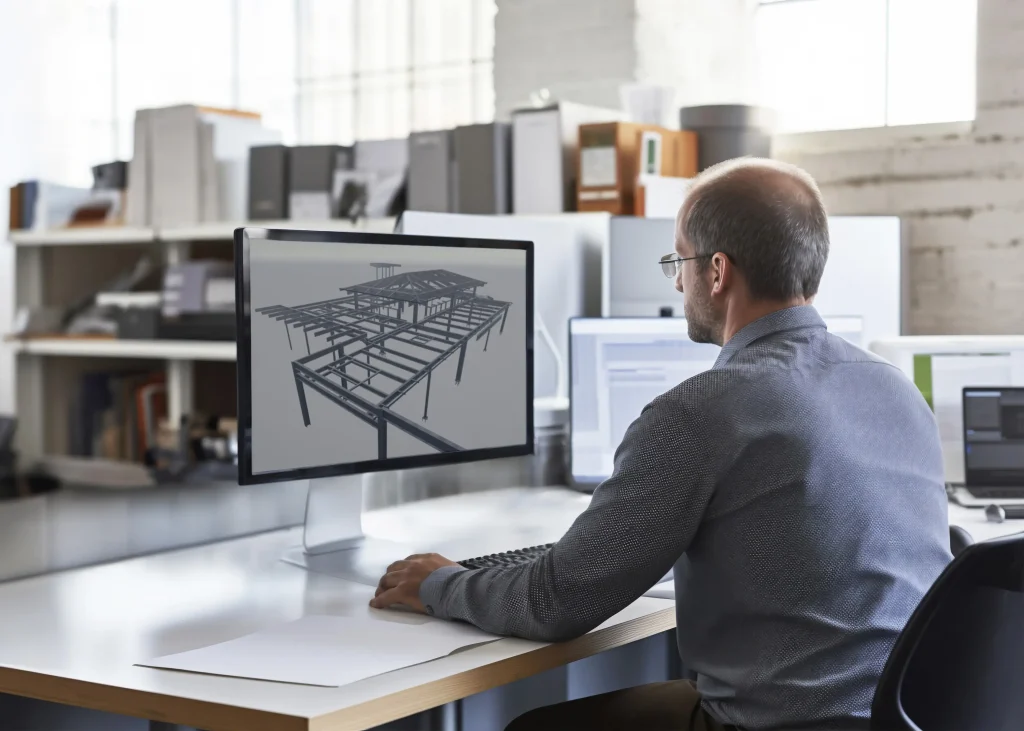
- Comprehensive 3D modeling (using tools like Tekla Structures) for early clash detection across trades.
- CNC-ready outputs that feed directly into fabrication equipment, slashing programming time.
- Rigorous quality checks—automated and manual layers—that reduce shop errors by up to 25 percent.
- Rapid RFI resolution (often 24–48 hours) to keep drawings moving.
As projects scale, single-source providers handling structural steel, miscellaneous metals, connections, and embeds become essential for coordination efficiency.
How Fabricators Can Capitalize on the Boom
Position your shop by securing detailing partners experienced in infrastructure-scale work. Look for teams that deliver:
- Fast turnarounds on large packages without quality trade-offs.
- Direct integration with your CNC lines.
- Proactive issue spotting during modeling.
- Scalable capacity for peak demand.
The 2026 landscape rewards those who move quickly and accurately. Early engagement with detailers allows better material forecasting, shop loading, and competitive bidding.
Frequently Asked Questions
How much steel will major 2026 infrastructure projects actually require? Individual large projects—such as high-speed rail segments, major bridge rehabilitations, or port expansions—can demand tens of thousands of tons. Aggregated across the national pipeline, structural steel consumption rises significantly, supporting steady mill output and fabrication volume through 2026 and beyond.
Is the $1.5 trillion figure realistic, or is it more about potential than committed funds? It reflects a mix: committed IIJA outlays, leveraged private/public partnerships, and proposed reforms to unlock permitting-blocked investments. While not all may materialize instantly, current trends show accelerating obligations and new grant announcements driving real project starts in 2026.
How can steel detailing help fabricators win more infrastructure bids? Accurate, rapid detailing provides reliable take-offs, realistic schedules, and reduced risk profiles—key factors in competitive bids. Clash-free models and CNC files demonstrate capability to deliver on time, giving an edge when owners prioritize proven execution.
Conclusion

The 2026 infrastructure boom represents a generational opportunity for America’s built environment—and for the steel industry that supports it. With trillions in potential investment channeling into roads, rails, grids, ports, and resilience projects, demand for high-quality structural steel and expert detailing has never been stronger.