Skip to content
Industrial facilities operate under relentless demands: heavy loads, continuous production, extreme conditions, and the need for minimal downtime. Whether it’s a massive distribution warehouse handling thousands of pallets daily, a manufacturing plant with vibrating machinery, or a refinery processing volatile materials, the steel framework must deliver unwavering performance. At T&J Steel Detailers, we specialize in industrial steel detailing that addresses these exact challenges, delivering precise, CNC-ready shop drawings that keep fabrication efficient and erection seamless.
We understand that industrial projects differ significantly from commercial or residential work. Schedules are tight, tolerances unforgiving, and any error can halt operations costing far more than the detailing fee. Our team uses advanced Tekla Structures modeling to create clash-free 3D environments, ensuring every beam, brace, platform, and connection fits perfectly the first time.
The Critical Role of Steel Detailing in Industrial Construction
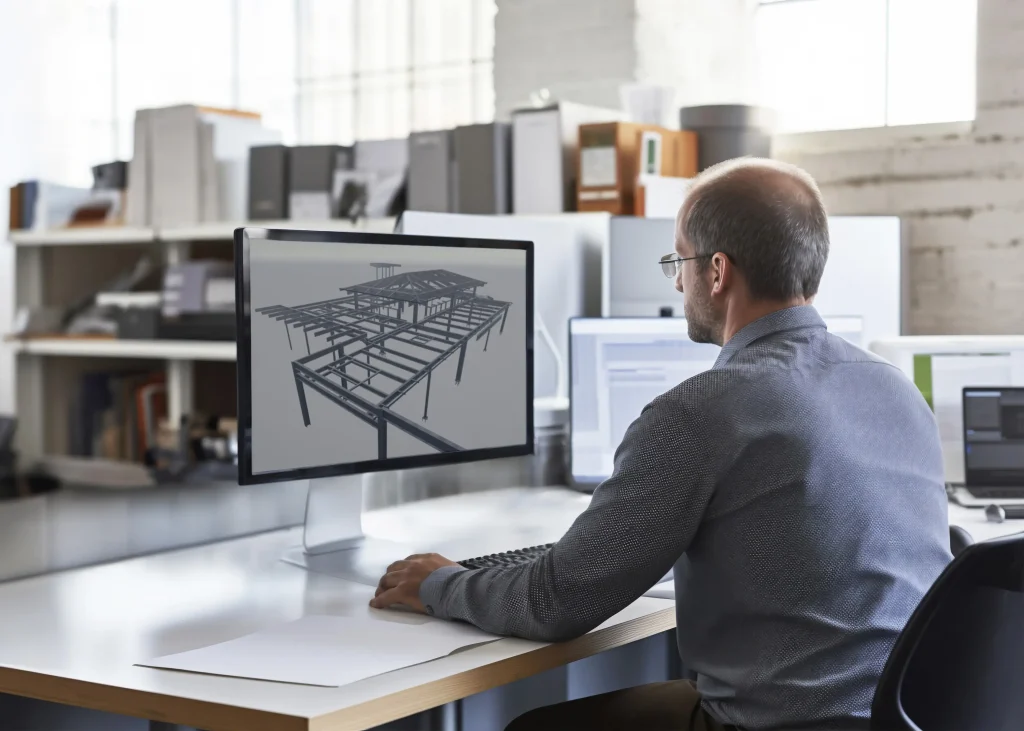
Steel detailing translates structural engineering intent into actionable fabrication instructions. For industrial applications, this means producing detailed shop drawings, erection plans, BOMs (bills of materials), and CNC files that account for dynamic loads, equipment integration, maintenance access, and future expansions.
In warehouses, detailing focuses on long clear spans and mezzanine systems. In manufacturing plants, it incorporates crane rails, vibration-resistant connections, and elevated platforms. In refineries, precision ensures pipe racks, equipment supports, and modular assemblies withstand harsh environments and meet stringent safety codes.
Accurate detailing prevents costly field modifications, reduces material waste, and accelerates overall project delivery—critical when industrial owners measure success in uptime rather than aesthetics.

The Benefits and Applications of Metal Structures
Steel structures dominate industrial construction for compelling reasons. Their combination of strength, adaptability, and efficiency makes them the material of choice for facilities that must perform reliably year after year.
Core Benefits of Steel in Industrial Settings
Superior strength-to-weight ratio enables longer spans and taller clear heights without excessive weight. This creates expansive, column-free interiors perfect for material handling, assembly lines, or storage racking—maximizing usable floor space while minimizing foundation costs.
Exceptional durability stands up to industrial abuse. Steel resists corrosion (with appropriate coatings), withstands heavy impacts, and maintains structural integrity under constant vibration or thermal cycling. In refineries and chemical plants, this resilience ensures long service life even in aggressive atmospheres.
Rapid construction and minimal site disruption accelerate occupancy. Prefabricated components arrive ready for quick assembly, allowing facilities to resume or begin production sooner. For expanding warehouses or plants adding production lines, steel’s speed translates directly to faster ROI.
Cost efficiency over the lifecycle shines brightest in industrial applications. Lower initial material costs compared to alternatives, reduced maintenance, and energy-efficient designs (with proper insulation) keep operating expenses down. Steel’s predictability also helps control budgets—no surprises from material variability.
Sustainability and recyclability align with modern industrial goals. Steel is infinitely recyclable without quality loss, and lighter structures require less concrete and transportation energy. Many owners now prioritize steel to meet ESG requirements while maintaining operational excellence.
Flexibility for adaptation future-proofs facilities. Steel frames can be modified, expanded, or reconfigured with relative ease—vital in manufacturing where processes evolve or in logistics where storage needs fluctuate.

Key Industrial Applications Where Steel Excels
Warehouses and Distribution Centers rely on steel for vast clear-span designs that support high-bay racking and automated systems. Wide column spacing (often 50–60 feet or more) optimizes storage density and forklift maneuverability.
Manufacturing Plants use steel to create robust frameworks that support overhead cranes, mezzanines, and heavy machinery foundations. Vibration control and precise alignment ensure equipment operates smoothly without compromising the structure.
Oil Refineries and Petrochemical Facilities demand steel for pipe racks, process towers, equipment supports, and modular skids. These structures handle extreme temperatures, corrosive environments, and high wind/seismic loads while allowing safe access for maintenance crews.
Power Plants and Processing Facilities benefit from steel’s ability to accommodate large boilers, turbines, conveyors, and exhaust systems. Modular detailing enables off-site prefabrication, reducing on-site work in controlled or hazardous areas.
In all these applications, superior steel detailing amplifies the material’s advantages—ensuring components integrate flawlessly, connections transfer loads correctly, and the entire facility performs safely and efficiently.

How We Address the Unique Challenges of Industrial Steel Detailing
Industrial projects present distinct hurdles: heavier sections, complex connections, integration with non-structural elements, and compliance with specialized codes. Our approach tackles each one head-on.
Advanced 3D Modeling with Tekla Structures
We build comprehensive, intelligent models that capture every detail—from primary framing to secondary supports and embeds. Clash detection runs continuously, identifying interferences with piping, HVAC, or equipment early.
Precision for Heavy Industrial Loads
We detail connections that handle dynamic and concentrated loads common in plants and refineries. Braced frames, moment connections, and base plates receive extra scrutiny to ensure stability under operational stresses.
CNC-Ready Outputs for Seamless Fabrication
All drawings and files export directly to your CNC equipment. This eliminates manual data entry, reduces programming time, and prevents transcription errors—especially valuable when processing large volumes of heavy members.
Rigorous Quality Assurance
Every model undergoes multiple checks: automated verification, manual dimension reviews, independent second-checks, and final senior approval. This layered process consistently achieves high accuracy and our reported 25% reduction in shop errors.
Fast Turnarounds and Responsive Support
We maintain capacity for industrial-scale projects, delivering structural packages in compressed timelines. RFIs receive responses within 24–48 hours, keeping your shop and field teams moving without interruption.
Full-Spectrum Industrial Detailing
We cover structural steel, miscellaneous items (platforms, ladders, handrails), joists, decks, and connection design. This single-source approach minimizes coordination issues and ensures consistency across packages.
Frequently Asked Questions

What makes steel detailing different for industrial projects like refineries versus standard commercial work? Industrial detailing must account for heavier loads, dynamic forces from machinery, integration with process equipment, and stricter safety/environmental codes. Precision in connections and supports becomes even more critical to prevent operational disruptions.
How does accurate detailing help reduce costs in warehouse or plant construction? It minimizes material waste, eliminates rework in the shop and field, accelerates erection, and prevents expensive downtime during commissioning. Clash-free models and CNC-ready files streamline the entire process from cut list to final bolt-up.
Can you handle rush detailing for urgent industrial expansions? Yes. We routinely support accelerated schedules with dedicated resources, rapid modeling, and same-day responses to critical questions—ensuring expansions or repairs happen with minimal impact on production.
Conclusion
Industrial facilities are the backbone of economies, and their steel skeletons must be engineered with exceptional care. At T&J Steel Detailers, we take pride in providing industrial steel detailing services that meet the rigorous demands of warehouses, manufacturing plants, refineries, and beyond. From the first model review to the final CNC download, our focus remains on precision, speed, and reliability.
When fabricators partner with us, they gain more than drawings—they gain confidence that their structures will support heavy operations day after day, year after year. The benefits of steel shine brightest when detailing eliminates variables and lets the material perform at its peak.