Skip to content
As steel fabricators, you already know that connections are where theory meets reality. A perfectly rolled beam or precisely cut gusset plate means little if the connection fails to transfer loads safely, efficiently, and economically. That’s exactly why we specialize in connection design services built exclusively for fabricators who demand AISC-compliant, shop-friendly, and cost-optimized solutions.
We understand the daily pressures you face: aggressive bid schedules, fluctuating steel prices, labor shortages, and the constant need to deliver projects without costly field modifications or engineer rejections. Our team exists to remove connection-related headaches from your workflow. Every bolted, welded, or pinned detail we produce is engineered to meet or exceed AISC 360 and AISC 303 requirements while being practical to fabricate in your shop and erect in the field.
Whether you’re bidding on industrial platforms, multi-story commercial buildings, heavy trusses, seismic retrofits, or miscellaneous steel packages, our connection designs help you win more work, reduce fabrication hours, minimize material waste, and protect your profit margins.

Why Connection Design Is the Make-or-Break Element for Fabricators
Connections typically account for 20–40% of the total steel tonnage cost, yet they receive disproportionate scrutiny from engineers, inspectors, and erectors. A poorly conceived connection can trigger RFIs, change orders, delayed approvals, or even structural concerns during erection. Conversely, a well-designed connection saves time, reduces labor, and gives you a competitive edge when bidding.
We approach every connection with three guiding principles:
- Code compliance first — Full adherence to the latest AISC Specification for Structural Steel Buildings (AISC 360-22) and Code of Standard Practice (AISC 303).
- Fabrication practicality — Designs that minimize specialty cuts, complex welds, and excessive fit-up time.
- Economic optimization — Balancing material efficiency, labor hours, and erection speed to deliver the lowest total installed cost.
Common Connection Challenges Fabricators Face—and How We Solve Them
Many fabricators we speak with share the same frustrations when working with generic engineering firms or in-house staff stretched too thin:
- Engineers specifying oversized plates and excessive bolts that inflate material and labor costs
- Welded connections that require preheat, multi-pass procedures, or back-gouging your shop isn’t equipped to handle efficiently
- Moment connections with impractical flange plate welding sequences
- Seismic detailing that overlooks ductility requirements or over-conservative assumptions
- Bracing connections that don’t account for real-world eccentricities or clearance issues
Our dedicated connection engineers—licensed structural professionals with years of fabrication-floor experience—tackle these issues head-on. We don’t just run numbers through software; we design with your shop capabilities, welder certifications, and typical material stocking in mind.
Bolted vs. Welded: Making the Right Choice for Your Shop
The bolted-versus-welded debate never ends because the optimal choice depends on project specifics and your operation. We provide clear, side-by-side comparisons for every critical connection so you can select the most economical and practical solution.
For example:
- High-strength bolted connections (slip-critical or bearing) often win on speed and quality control, especially when your shop has reliable drill lines and your erectors prefer field-bolted assemblies.
- Complete-joint-penetration (CJP) groove welds may be preferred for moment frames, but we frequently recommend alternatives such as bolted flange plates with fillet-welded webs to reduce preheat requirements and inspection costs.
We document every assumption—load paths, eccentricity effects, prying action, block shear, bolt shear planes—so your team can defend the design during submittal reviews or value-engineering discussions.
Our Comprehensive AISC-Compliant Connection Design Process
We follow a transparent, repeatable workflow that integrates seamlessly with your detailing and fabrication pipeline.
Step 1: Early Collaboration and Load Take-Off
We start by reviewing the structural drawings, loading criteria, and project specifications together with you. During this phase we identify:
- Governing load combinations (including seismic and wind)
- Connection types required by the engineer of record (simple, partially restrained, fully restrained)
- Special considerations (fire protection, fatigue, corrosion protection)
- Your shop’s preferred connection preferences and equipment limitations
This upfront alignment prevents downstream surprises and accelerates approval cycles.
Step 2: Advanced Analysis and Design Using Industry-Leading Tools
Our engineers utilize:
- RISAConnection for code-compliant checks on standard and custom configurations
- RAM Connection for moment, shear, and braced-frame connections
- Tekla Tedds and custom Excel tools for specialized cases (end-plate moment connections, HSS connections, extended single-plate shear tabs)
- AISC Manual Tables cross-referenced with the latest design examples and companion resources
Every design includes full calculation packages with clear load paths, interaction equations, and code references—ready for engineer stamps or third-party reviews.
Step 3: Shop-Friendly Detailing Integration
We don’t stop at engineering calculations. We deliver connection designs in formats your detailers can use immediately:
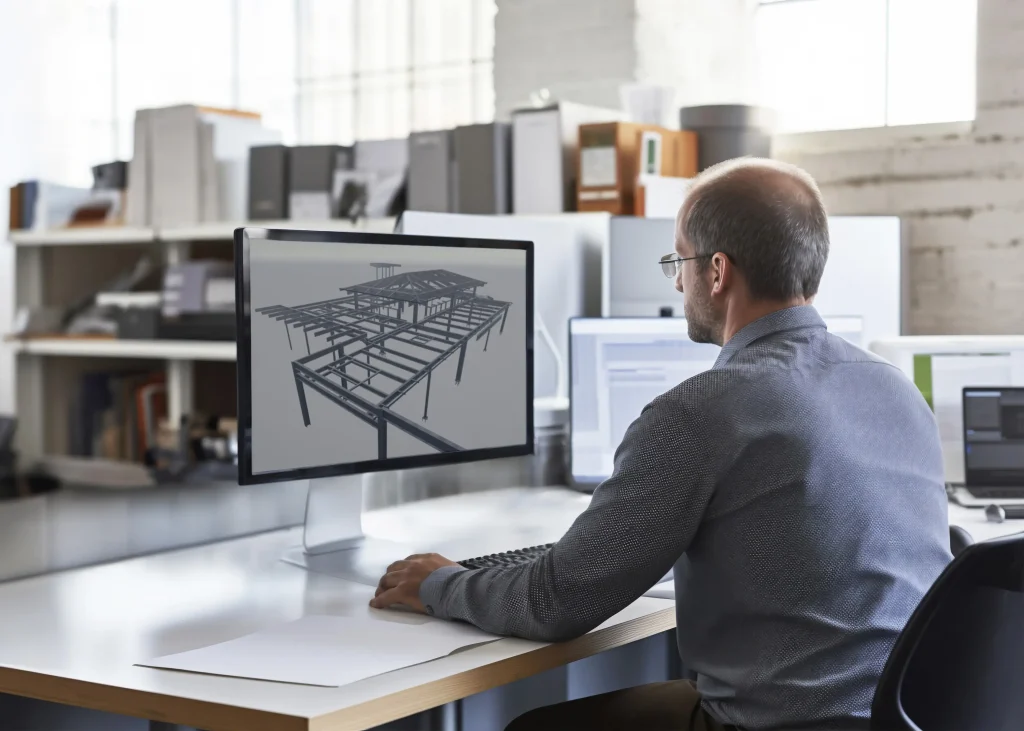
- Annotated 3D model views showing plate dimensions, bolt patterns, weld sizes, and cope details
- Detailed connection schedules with part numbers, material grades, and quantities
- Weld procedure recommendations aligned with AWS D1.1 and your certified welding procedures
- Bolt installation requirements (turn-of-nut, calibrated wrench, tension-control bolts)
If you already use Tekla Structures, SDS/2, or Advance Steel, we provide native files or parametric components that streamline incorporation into your shop drawings.
Step 4: Rigorous Quality Review and Documentation
Before final delivery, every connection passes through:
- Peer review by a second licensed engineer
- Automated code-check verification
- Fabrication feasibility checklist
- Clear, professional calculation reports with cover sheets, table of contents, and revision history
This level of documentation builds confidence with reviewing engineers and reduces RFI volume dramatically.

Key Benefits Fabricators Gain from Our AISC Connection Design Services
Partnering with us delivers tangible, measurable advantages:
Reduced Material and Labor Costs
Optimized plate sizes, bolt counts, and weld volumes often cut connection costs by 10–25% compared to conservative engineer-provided details—without sacrificing safety.
Faster Approval Turnaround
Our calculation packages are thorough yet concise, using AISC-preferred formats and terminology. Engineers approve them faster because they don’t have to hunt for missing information.
Fewer Field Problems
Connections designed with real-world erection tolerances, clearance, and fit-up in mind mean less grinding, reaming, and field welding—keeping erection crews productive and GCs happy.
Competitive Bidding Advantage
When you can confidently bid lower unit prices on connections while maintaining healthy margins, you win more work. We’ve helped fabricators turn previously lost bids into profitable contracts simply by offering smarter, more economical connection solutions.
Seamless Support for Complex and Specialty Connections
We excel at non-standard situations:
- High-seismic moment connections (reduced beam section, bolted flange plates with extended double angles)
- HSS slotted connections with through-plates or cap plates
- Heavy-pin connections for truss bottom chords
- Connections to existing structures (retrofit plates, core drilling coordination)
- Fatigue-resistant details for crane runways and bridge applications
No connection is too unusual or too demanding—we treat every one as an opportunity to showcase precision engineering.
Frequently Asked Questions
Do your connection designs come with engineer-of-record stamping?
While we provide fully engineered, AISC-compliant calculations and details prepared by licensed structural engineers, final sealing typically remains with the project’s engineer of record. We deliver packages designed to be easily reviewed and stamped, often reducing their effort and accelerating approvals.
How do you handle value engineering requests or last-minute load changes?
We maintain a rapid-response team for VE proposals and design revisions. Most changes are turned around within 2–5 business days, with clear documentation of cost impacts and code compliance.
Can you integrate your connection designs directly into our existing Tekla or SDS/2 models?
Yes. We routinely supply parametric connection components, custom component files, or fully modeled assemblies that your detailers can insert or reference, saving significant modeling time.

Conclusion
In today’s demanding steel fabrication landscape, having a reliable partner for connection design isn’t a luxury—it’s a competitive necessity. We combine AISC expertise, practical fabrication insight, and advanced engineering tools to deliver connections that are safe, economical, and buildable.
If you’re tired of oversized plates, excessive welds, rejected submittals, or connections that look great on paper but create headaches in the shop or field, we invite you to experience the difference our specialized service makes. Reach out today to discuss your current or upcoming projects—whether it’s a single bracing connection package, a full building’s worth of moment frames, or a complex industrial retrofit.