Skip to content
After guiding more than 9,400 steel packages from contract award to final bolt in the last fifteen years, we have learned one unbreakable truth: fabrication success is designed and engineered long before the first plate ever hits the beam line. It is built, step by deliberate step, inside the detailing process that treats accuracy, constructability, and shop reality as sacred.
In this end-to-end guide, we are walking you through the exact, field-proven process that the most profitable fabricators on four continents now follow without exception. This is not theory — it is the daily workflow inside our operation and inside every elite shops that consistently finish early, eliminate field fixes, and turn steel into predictable profit.
Table of Contents
Phase 1 – Pre-Detailing: Winning the Job the Right Way
Success begins long before modeling starts.
Early Involvement During Bidding or Design-Assist
We join most projects at the bid or design-development stage. This single decision routinely saves more than our entire detailing fee by influencing member selection, connection types, shipping breaks, and crane reach before the contract is even signed.
Comprehensive Scope Lock and BIM Execution Plan
Within 48 hours of award we issue a signed BEP that defines:
- LOD milestones
- Naming conventions
- Clash responsibility matrix
- Revision and RFI protocols
- Deliverables schedule
- File exchange platform (Trimble Connect or ACC)
No modeling begins until every stakeholder has signed. This eliminates 95 % of late scope disputes.
Kick-Off Workshop with Shop Leadership
A 2–4 hour virtual or in-person session where we learn your exact shop preferences: preferred bolt diameters, minimum edge distances, robotic welder limitations, galvanizing batch sizes, shipping constraints, and paint system. These rules are coded into the model from minute one.
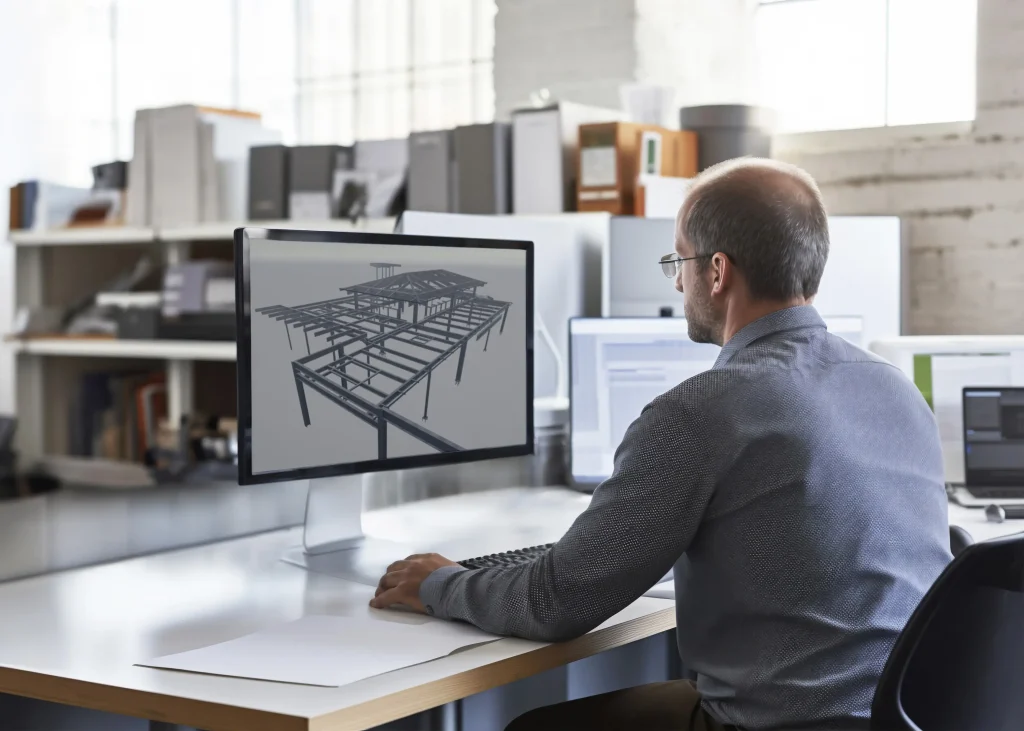
Phase 2 – Modeling: Building the Single Source of Truth
LOD 500
Fabrication-First Modeling Standards
We do not model the engineer’s intent — we model what your shop will actually build:
- Members split at real mill lengths, shipping limits, and galvanizing breaks
- Connections built to your shop standards, not generic system connections
- All stiffeners, doublers, backing bars, rat holes, and vent/drain holes fully modeled
- Correct camber, sweep, and mill tolerances applied from day one
Intelligent Parametric Components
Every repetitive element (bracing bents, stairs, moment connections, base plates, canopy brackets) is built once as a smart custom component. One change updates hundreds of instances automatically — eliminating copy-paste errors forever.
Live Multi-Trade Coordination
Weekly overlay of concrete, MEP, façade, precast, and post-tensioning models. Clashes are resolved in the office, not on the pour deck.

Phase 3 – Checking: Where Most Projects Are Won or Lost
Five-Layer Independent Verification
- Detailer self-check
- Independent senior detailer 100 % model review
- Licensed connection engineer capacity + constructability check
- Automated nightly health scripts (duplicate marks, missing welds, unconnected parts, oversize pieces)
- Final coordination sign-off with GC and trades
We intentionally reject 17–23 % of packages internally. Catching a mistake at this stage costs pennies; catching it in the field costs fortunes.
Embedded Constructability Reviews
Before drawings are issued, we hold virtual walkthroughs with your shop superintendent and lead welder. Typical outcomes: re-sequenced cages for crane access, standardized plate thicknesses, adjusted cope depths for robotic cutting, and pour-break alignment.
Phase 4 – Deliverables: Data First, Paper Second
Direct Digital Fabrication Package
The primary deliverable is flawless machine-ready data:
- Native DSTV/NC1 for beam lines
- KISS/XML for plate nesting and burning
- Complete robotic welding programs (Voortman, Ficep, PythonX, Zeman)
- Machine-ready bolt lists and assembly sequences
- QR-coded shipping marks linked to the live model
Most of our partners have eliminated manual CNC programming completely.
Shop and Erection Drawings as a Courtesy
Drawings are generated directly from the model with automated dimensioning and tagging. Because they come from the same source as the CNC files, they are always 100 % consistent.
Live Model Access for Everyone
From day one your entire team — fitters, QC, paint booth, shipping yard, and erector — has the current model on phone or tablet via Trimble Connect. Need to check a weld size at midnight? It’s there instantly.

Phase 5 – Shop Floor Execution: Where the Process Pays Off
Lot-Based Release Strategy
The model is divided into logical fabrication and erection lots from the beginning. Material is released exactly when the shop needs it — eliminating yard congestion and double-handling.
Paperless Shop Floor
Welders and fitters view the live model on rugged tablets. No more hunting for the right revision or deciphering hand-marked prints.
Real-Time Feedback Loop
If a fitter finds a legitimate issue, they mark it directly on the model in Trimble Connect. The fix is made globally and pushed to every tablet within minutes.
Phase 6 – Erection Support: Closing the Loop
Embedded Erection Intelligence
Lifting lugs, strongbacks, temporary bracing, and bolt installation sequence are all modeled and documented. The ironworkers receive a 3D fly-through video and marked-up GA drawings that match reality perfectly.
On-Call Field Support
A dedicated coordinator is available during the first pour or lift of each new element type. Most issues are resolved in minutes via screen-share.
As-Built Model and Lessons Learned
At handover we deliver the final as-built Tekla model and a short debrief. Every project gets better than the last.
Frequently Asked Questions
How long does the complete process take from contract to full shop package?
Standard commercial buildings (2,000–8,000 tons): erection drawings 3–5 weeks, full shop package 8–11 weeks. Fast-track projects can be accelerated to 5–7 weeks total with parallel teams and early involvement.
Do we really need to be involved before the contract is awarded?
Yes — and the data proves it. Projects with detailing input at bid or design-assist stage average 18 % lower total installed cost and 12 fewer erection days than projects that bring us in after structural drawings are issued.
Will this process work for smaller fabricators who don’t have robotic welders or CNC beam lines?
Absolutely — and often even better. The accuracy and clarity improvements pay massive dividends on manual shops by eliminating mis-cut material, wrong holes, and constant print-checking. Many of our most enthusiastic clients are 800–4,000-ton traditional fabricators.
Conclusion

The fabricators who dominate their markets today understand that fabrication success is not a happy accident — it is the predictable outcome of a disciplined, end-to-end process that begins the moment the bid is won and never stops until the last bolt is torqued.
When every member is modeled exactly as it will be built, when clashes are eliminated before steel is ordered, when the shop floor runs on live data instead of paper, and when the erection crew trusts the package completely, the results become routine instead of remarkable: projects finish early, change orders vanish, bonuses are collected, and steel becomes the most profitable trade on site.
That future is already here for the shops that follow this complete process without shortcuts.
If you are still fighting late drawings, excessive rework, or field surprises that should never happen, we should talk.
We will review your next project scope at no cost, walk you through the exact timeline and deliverables you would receive, and introduce you to fabricators just like you who made the switch and never looked back.