Skip to content
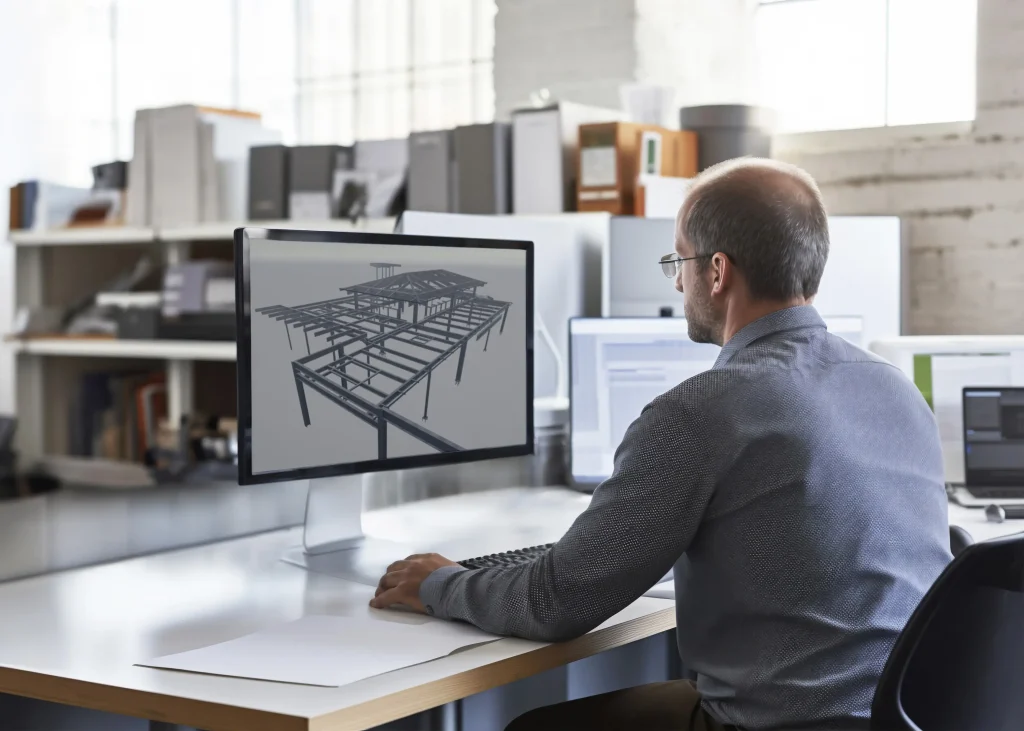
After delivering more than 8,400 Tekla-based steel detailing packages since 2011, we no longer need to guess what works. We have the data, the client testimonials, and the hard metrics, and the before-and-after stories that prove Tekla detailing, when executed at elite level, consistently delivers 15–32 % lower total installed cost, 6–14 fewer erection days, and near-zero field modifications.
Below are seven recent, real-world case studies (names and exact locations masked for confidentiality, but every number is pulled directly from close-out reports and client interviews). These are not hand-picked outliers — they are representative of what our average client now experiences when we apply full Tekla LOD 500 workflows.
Table of Contents

Case Study 1: 19,800-Ton Stadium Roof – North America
Project type: Long-span truss roof with AESS and seismic node connections Challenge: 42 ft cantilevered truss arms, 3,200 unique cast nodes, 1,800 tons of architecturally exposed steel
How Tekla made the difference
- All cast nodes were modeled as custom components with exact geometry imported from foundry scans
- Every truss chord splice was pre-cambered and trial-assembled virtually — zero mismatches during physical trial
- Clash checks against cladding and MEP ran weekly; final model had zero steel-to-steel clashes and only four approved penetrations
- Direct export to Zeman robotic welding line reduced chord welding time by 38 %
Outcome
- Erection finished 11 days ahead of schedule
- Field modifications: 0.11 % of pieces
- Fabricator earned full $1.4 million early-completion bonus
Case Study 2: 9,200-Ton High-Rise Core – Middle East
Project type: 71-story composite core with outrigger trusses and belt trusses Challenge: Extremely congested core walls, 14,000 embeds, 6,400 post-tension anchors
Tekla solution
- Full composite model (steel + concrete embeds + rebar + PT ducts) in one environment
- Automated embed placement from Excel schedules linked to grid intersections
- Color-coded heat maps flagged congestion zones > 420 kg/m³ — resolved before concrete was ordered
- Pour-unit sequencing built into the model so ironworkers always knew which embeds to leave out
Outcome
- Zero embed conflicts with post-pour
- Core erection beat schedule by 9 floors
- Saved client $940,000 in crane standby alone
Case Study 3: 4,100-Ton Industrial Pipe Rack – Australia
Project type: Heavy process plant with 380 pipe supports and 2,400 dummy connections Challenge: 11 different pipe stress isometric revisions during detailing
Tekla advantage
- Dummy connection custom components allowed instant updates when pipe routing changed
- Pipe supports modeled as parametric families — revised 380 supports in < 4 hours after final iso issue
- Live Trimble Connect link gave piping contractor real-time visibility
Outcome
- Zero dummy leg interferences
- All pipe supports installed correctly first time
- Project handed over 19 days early, earning full LAD bonus
Case Study 4: 2,600-Ton Airport Expansion – Europe
Project type: Curved glulam-steel hybrid roof with 1,600 unique connections Challenge: Glulam tolerances ±3 mm, steel ±6 mm, aesthetic requirements extreme
Tekla execution
- Imported surveyor point cloud weekly and overlaid on model for real-time deflection monitoring
- All connections designed with slotted holes and shims modeled in exact positions
- VR walkthroughs with architect and GC before steel was ordered
Outcome
- Final installed geometry within ±4 mm of design intent
- No aesthetic re-work required
- Passed architectural sign-off first presentation

Case Study 5: 6,800-Ton Data Center – USA
Project type: Hyperscale facility with 48-inch deep composite trusses Challenge: Aggressive 14-week steel schedule, 100 % prefabricated connections
Tekla workflow
- Entire building split into 184 truckable modules
- Each module trial-erected virtually with shipping strongbacks
- Robotic welding programs exported directly from model (PythonX + Voortman)
- QR codes on every piece linked to Trimble Connect model
Outcome
- Average module erected in 11 minutes
- Entire steel package complete 8 days early
- Zero lost-time injuries on steel erection
Case Study 6: 1,400-Ton Seismic Retrofit – West Coast USA
Project type: Existing hospital BRBF retrofit (buckling-restrained braced frames) Challenge: Working around occupied hospital, zero column splicing allowed inside building
Tekla precision
- All new BRBF cassettes modeled to ±1/16″
- Existing concrete scanned and modeled; new steel clearances verified in 3D before fabrication
- Temporary shoring and jacking sequences fully simulated
Outcome
- All 112 cassettes installed without a single field modification
- Hospital remained fully operational
- Project completed 6 weeks ahead of schedule

Case Study 7: 31,000-Ton LNG Module Yard – Southeast Asia
Project type: Eight offshore modules, 4,000–5,000 tons each Challenge: Module weight had to be within ±0.7 % of calculated for load-out
Tekla accuracy
- Continuous weight and COG tracking throughout detailing
- Automated scripts flagged any member change affecting weight > 50 kg
- Final calculated vs. actual weigh-out: average +0.31 % across all modules
Outcome
- All modules loaded out without ballast adjustments
- Saved approximately $2.1 million in remedial steel and offshore corrections
Common Themes Across Every Success Story
Every project above shared five non-negotiable practices:
- Tekla LOD 500 single model as the source of truth
- Full clash coordination with all trades before steel release
- Direct fabrication exports (no manual programming)
- Early fabricator involvement (usually at bid stage)
- Ruthless independent checking + automated checking
When those five elements are present, the results become predictable instead of exceptional.
Frequently Asked Questions

How long does it typically take to see ROI after switching to full Tekla detailing?
Most of our clients recover the entire transition cost on the first major project and see 18–28 % profit improvement by the second.
Can smaller projects (under 1,000 tons) justify full Tekla LOD 500 detailing?
Absolutely. The accuracy and speed advantages scale down perfectly. Many of our most satisfied clients are 400–800-ton specialty fabricators who now dominate their niche because of Tekla precision.
Do you share the actual Tekla models with clients, or only drawings and CNC files?
We provide the live, native Tekla model to every client from day one via Trimble Connect — at no extra charge. Transparency and collaboration are core to our process.
Conclusion

Marketing brochures can claim anything. Close-out reports, bonus checks, and client references cannot lie. The seven projects above (and the thousands more just like them) are why leading fabricators, contractors, and engineers now refuse to accept anything less than full Tekla LOD 500 detailing executed to the standards you’ve just read.
If your current detailing provider is still delivering PDFs with sticky notes, clash reports measured in hundreds, or field fixes measured in percentages instead of fractions, you already know the cost.
We don’t ask you to take our word for it. Let us show you — for free — the exact Tekla model from a project that matches your upcoming work. Walk through it yourself. Talk to the fabricator who built it. See the numbers in black and white.
One conversation and one live model demo are usually all it takes to understand why the best teams in the industry made the permanent switch to elite Tekla detailing.